
Over the past 15 years as a sleep consultant, I’ve worked with thousands of breastfeeding moms. One of the most common questions is “How often should I breastfeed” and the age of their baby. This post will share a breastfeeding frequency by age chart and some information about helping your baby sleep through the night!
In this article:
How Often Do Babies Breastfeed?
How often babies breastfeed depends on various factors including the following:
- Age – The age of your baby will matter because your baby’s milk needs will increase as they get older and more mobile and active.
- Stomach Size – This goes hand-in-hand with age but because some babies will have small stomach sizes even as they get older, it is worth it to point out that it’s separate from age.
- Appetite – Just like adults, some babies and toddlers have small appetites and some will have large appetites. In addition, some people are “breakfast people” while others prefer to eat more of their calories later in the day.
- Personality – Some babies LOVE to eat while others seem to take it or leave it. In addition, some babies eat just until they feel satiated while others fill themselves up more.
- Health Concerns – Babies with reflux tend to breastfeed more often because they avoid overfilling their stomachs. Other health concerns can impact your baby’s feeding habits, too.
I breastfed both of my sons and my first son breastfed more often because he didn’t like the feeling of being overly full. He maintained that habit even as he became a young adult where you could witness him putting down a cookie half-eaten! His younger brother tended to take bigger feedings less frequently than he did as a baby.
Keep in mind that everyone is different but here is some information on average breastfeeding frequency by age:
Breastfeeding Frequency During the First Week
It’s not uncommon for babies who are one week old to breastfeed every 1-2 hours all day and night. Sometimes it might feel like all you do is feed the baby! Follow your baby’s cues and feed on demand every time they show hunger signs.
If your baby is sleeping a lot, however, your doctor will likely tell you to wake the baby to feed them every 2-3 hours. It is vitally important for your newborn baby to put on weight and they must breastfeed 10-12+ times a day in order to do so. This will also help your milk supply! Always remember that breastfeeding is a demand -> supply relationship. Even if you think you don’t have enough milk, your baby’s “demand” will tell your body to make more. Be sure to talk to a lactation consultant if you have any concerns about your milk supply, latch, or any other breastfeeding concerns.
Average Total Feedings Per Day: 10-12 Times
Newborn Breastfeeding Frequency
Most newborns breastfeed every 2-3 hours though cluster feeding in the evening is very common. Newborns will often cluster feed every hour leading up to bedtime in order to “tank up” so they can do their longest stretch of sleep. It might feel like your baby is attached to the breast nonstop during these cluster feeds. This stage ends by 3 months old, on average.
If your baby is sleeping a lot during the day and eating all night, this is called newborn reverse cycling and could be caused by day/night confusion. If you are trying to get your newborn to sleep through the night using the 12 Hours by 12 Weeks Method, note that not ALL babies this age can go 4 hours between feedings during the day.
Average Total Feedings Per Day: 6 to 9 Times
Breastfeeding Frequency 4-5 Months
4- to 5-month-old babies breastfeed every 2 1/2 to 3 hours during the day. At night, most babies this age will sleep one 4-5-hour stretch and then breastfeed every 3 hours for the rest of the night. It’s not uncommon for a 4-month-old to eat every 2 hours after 3 a.m. as they approach morning if they have done a longer 5-8-hour stretch earlier in the night. If your baby is waking up every 1-2 hours to breastfeed, they have most likely hit the 4 month sleep regression which is a different issue.
Average Total Feedings Per Day: 6 to 7 Times
Breastfeeding Frequency 6-7 Months
6- to 7-month-old babies usually breastfeed every 3 hours during the day and eat 1-2 times at night. Most babies this age can do one solid 5-8-hour stretch of sleep at night without breastfeeding. We can typically transition to one night feeding around this age though some babies are still nursing twice a night.
Average Total Feedings Per Day: 6 Times
Breastfeeding Frequency 8-9 Months
At 8 to 9 months old, babies typically breastfeed every 3-4 hours during the day and wake just once for night feedings if at all. Some babies can be night-weaned completely though it often depends on how much solid food your baby is eating. If you aren’t sure if your baby is ready, be sure to review the 3 signs it may be time to night-wean and/or take our quiz about whether it’s time tonight-wean.
Average Total Feedings Per Day: 5 to 6 Times
Breastfeeding Frequency 10-11 Months
Babies who are 10 to 11 months old breastfeed every 3-4 hours during the day and are usually sleeping through the night for 10-12 hours straight. Most 10-11 month old schedules have two naps and 4-5 breastfeeding sessions per day.
Average Total Feedings Per Day: 4 to 5 Times
Toddler Breastfeeding Frequency
The breastfeeding frequency for toddlers varies widely from 1 to 4 times a day, on average. Some toddlers are only nursing once in the morning and once at bedtime while others are still breastfeeding every 3 hours. There is no right or wrong but if you are looking to make a change, consider following an age-appropriate toddler schedule.
Average Total Feedings Per Day: 2 to 4 Times
How Long Do Breastfeeding Sessions Take?
Newborn breastfeeding sessions can take a long time often up to 20+ minutes on each side. As babies get older, more proficient, and have stronger muscles for nursing, they can often finish eating in 5-10 minutes per side. At night, when they are sleeping, they could become so proficient that they finish nursing in 5-8 minutes total.
How to Know If Baby Is Getting Enough Milk
The best way to know if your baby is getting enough milk is by their weight gain and the number of wet and dirty diapers. During a feeding, you should be able to hear or see your baby swallowing milk. And, after a feeding, your baby should seem content and happy. And, after the first week, your baby should be having at least six wet diapers per day. Be sure to talk to your doctor if you have any concerns whatsoever or consider talking to a lactation specialist.
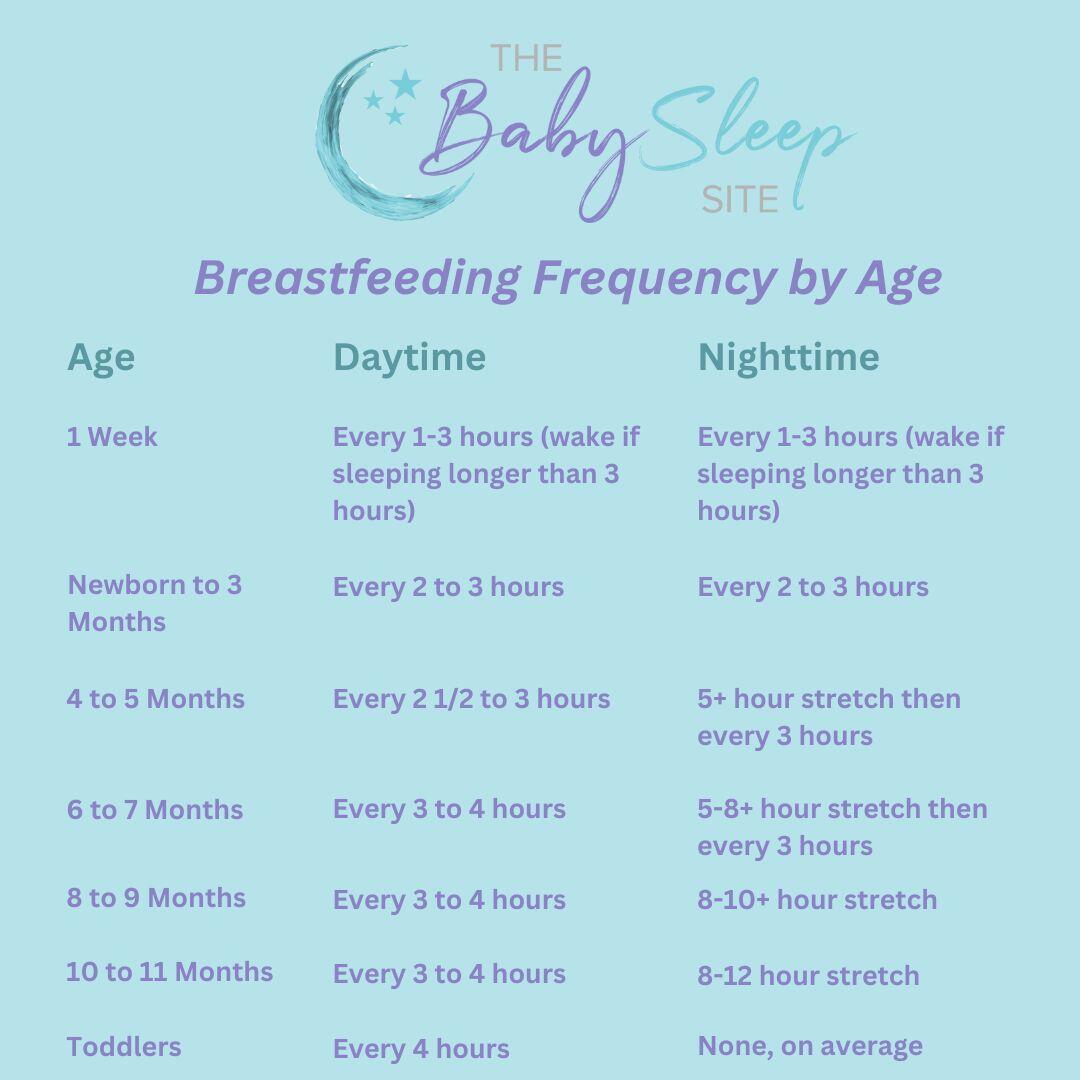
Breastfeeding Frequency By Age Chart
As your baby grows, you may or may not see your breastfeeding sessions get further apart. Your baby’s caloric needs will grow especially as they become mobile. For convenient reference, we created this breastfeeding frequency by age chart but always keep in mind that your baby is unique!