

Sunshine Billingual The Blog
    Top Picks
    Infant

    Funny Pregnancy Valentine’s Day Memes

    Infant

    15 moms share what it’s really like to have a miscarriage

    Toddler Care

    Baked Sheet Pan Nachos (with Potatoes and Beans)

    Important Pages:
    • MainHome
    • Blog
    • Programs/Tuition
    • Our Team
    • Himama app
    • Gallery
    • Contact Us
    • Privacy Policy
    • Terms & Conditions
    Facebook X (Twitter) Instagram Pinterest
    Sunshine Billingual The Blog
    • MainHome
    • Programs/Tuition
    • Our Team
    • Himama app
    • Gallery
    • Contact Us
    • Infant

      Parenting Gifted Children – Babywise Mom

      20 Common Baby Myths Parents Still Believe

      37 Kid-Friendly Halloween Movies for Families

      Kids Music (That Doesn't Suck)

      Managing Schedules on Halloween Night (Naps & Bedtime Tips)

    • Child Care

      The Role of Software in Boosting Parent Satisfaction

      5 Signs Your Center Needs Curriculum Management Software

      A Day in the Life with LineLeader’s All-in-One Platform

      Strong Parent-Childcare Relationships: Why Communication Matters

      Creative Childcare Hunter Streets Role In Early Learning Services.

    • Toddler Care

      Pumpkin Baked Oatmeal – Yummy Toddler Food

      Fresh Apple Pancakes – Yummy Toddler Food

      Apple Oatmeal Bars – Yummy Toddler Food

      Favorite Carrot Pasta Sauce – Yummy Toddler Food

      Pumpkin Bars with Cream Cheese Frosting

    • Preschool

      Updates to Horizon’s Preschool Programs

      Ohio DCY Leadership Pay a Visit to Horizon

      4 Ways To Make Preschool Dropoff Easier

      How Do Preschoolers Learn Best?

      Why Are Science Experiments Important for Preschoolers?

    • Learning

      Week of the Young Child in 2024: Activities, Themes + Ideas

      Keys to Building a Strong Workforce in Your Childcare Business

      How Childcare Software Makes a Difference: According to Real Educators

      LineLeader’s Passion for Education Meets Tech Innovation in their Leading Childcare Software

      5 Signs It’s Time for a User-Friendly CRM System

    • Skill

      When Should I Start To Give My Child an Allowance?

      New Study Finds Not All Preschool Programs Are Equal

      The Amazing Ways Preschool Expands Children’s Brains

      Happy Classrooms Lead to Healthy Communities

      Why Preschool Is Vital to Academic Success

    • Activities

      Fostering a Love of the Outdoors in kids

      Immunity Booster Foods for Kids this monsoon

      Indoor games & activities for kids in monsoons

      Tummy Time Must know tips for Infants

      Top 5 Indoor Games for Your Toddler

    • Parenting

      [Press] LineLeader by ChildcareCRM Is Shortlisted for 12 Cloud Awards

      Parent Engagement Software That Boosts Enrollment & Retention

      Why a Childcare Booking System Is Key to Enrollment Success

      The Best Childcare CRM for Enrollment in 2025

      Build a System That Converts

    • Leadership

      Best Childcare Attendance Software for Your Center

      How 100+ Years of Education Experience Shapes LineLeader’s Service Commitment

      5 Insights Every Multi-Site Owner Can Apply

      Developmentally Appropriate Practice (DAP) Examples

      5 Data-Backed Ways to Win Parent Trust

    • Features

      Teaching Children Responsibility | AMC October Value

      Horizon Unveils New Lakewood Location

      🌟 Fun and Positive Ways to Teach Kids Rules at Home

      🌟 Why Rules Matter: Building Safety and Kindness at Home

      How To Build Strong Study Habits—With Support From Horizon & Local Libraries

    Sunshine Billingual The Blog
    Home » When Do Babies Start Walking?
    Infant

    When Do Babies Start Walking?

    Share Facebook Twitter Pinterest WhatsApp
    Share
    Facebook Twitter Pinterest WhatsApp

    If you’re wondering when babies start walking, taking their first steps involves the coordination of several factors. An infant’s developing muscles, sense of balance, and ability to build upon skills used for sitting and standing all contribute to their achievement of the walking milestone.1 Here, you will learn about when this can happen, signs your child will walk soon, how you can support your baby’s first steps, and reasons for late walking in babies.

    You may be wondering about the age at which babies begin taking their first steps. Kids start walking at different ages, so while 12 months is the average age, your baby may take their first steps months earlier or later. Most babies learn to walk anywhere from 9 to 17 months. Once they learn to walk, it may take some time for them to maintain their balance consistently.4

    To learn how to walk, your baby will build upon skills they have already mastered. These include rolling over, sitting up, crawling, etc.2 Some babies prefer to scoot or slither around instead of crawling.3 Once they learn how to pull themselves up to standing, they may hold on to furniture or your legs.8

    After your baby has mastered this skill, they can begin to cruise along furniture. As their balance improves, they may practice standing without holding on to anything.5 Next, as your baby’s confidence increases, they may take their first shaky steps. You may notice at first that their feet are wide apart.2 This stance is temporary while they work to improve their balance.4 Their initial attempt at walking will likely not get them very far, but many toddlers progress from taking their first steps to actual walking within days.5

    These milestones are signs your baby will start to walk independently soon:4,8

    • Your baby can pull themselves up to a complete stand.
    • They are holding onto furniture while taking steps.
    • They can stand without holding on to anything.

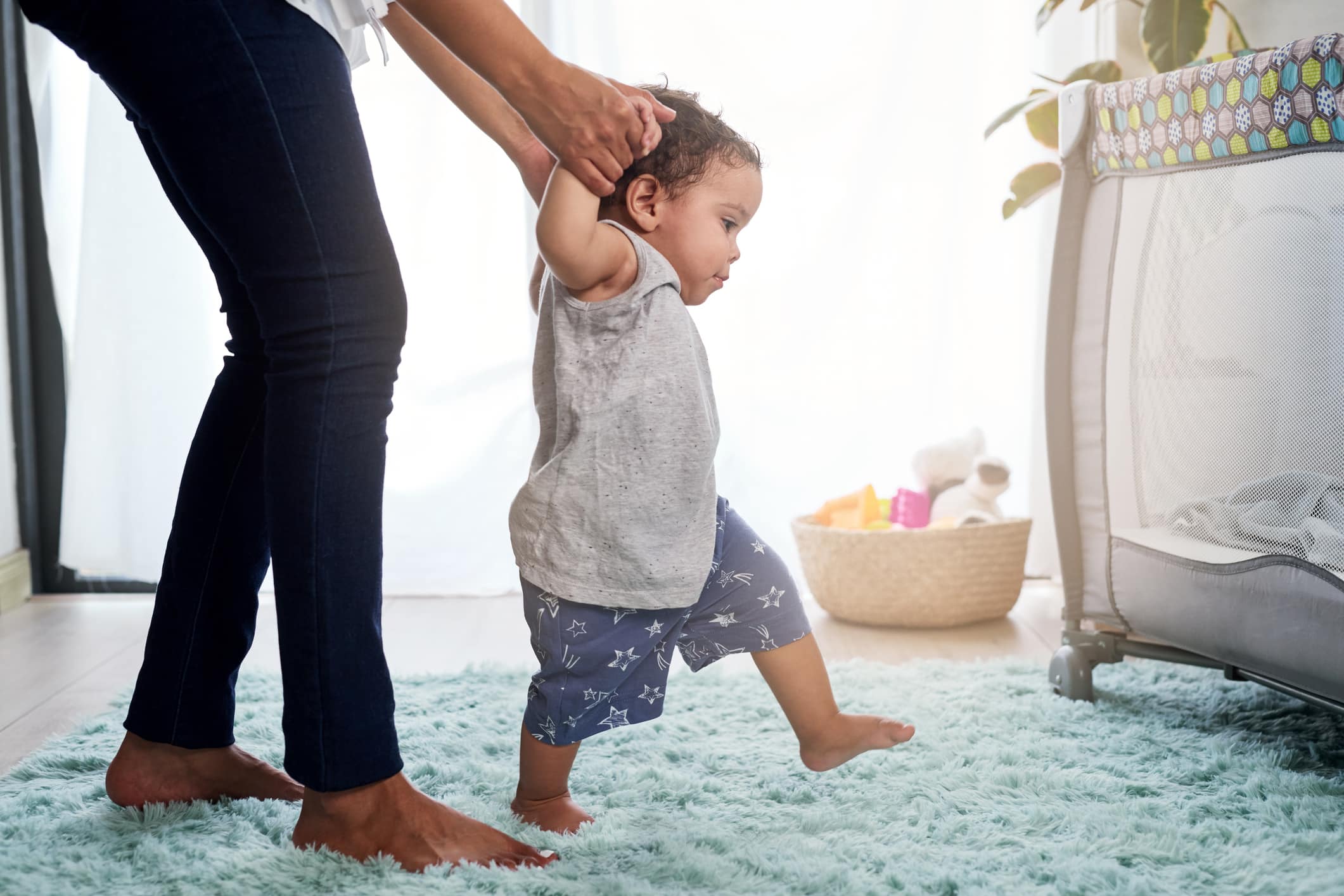
    Once your baby can stand independently, you can help them learn to take their first steps by holding their hands and walking with them.4 Being physically close to your child as they explore this new skill may help them feel safe as their confidence gradually increases. They can also practice independently by pushing a flipped-over laundry basket or steady and supportive push toys around the house.4 To encourage your baby’s first steps, you can try standing at a short distance and motivating them to move toward you by showing them a fun toy.5

    Creating a safe environment for your infant as they learn to walk is key to avoiding accidents. But unfortunately, falls are inevitable.8 When your child falls, offer a quick, comforting hug and encourage them to try again. They will be looking at your reaction to their accident. If you remain calm, you can provide your child with sturdy reassurance.2

    First steps of a child with his father's help. Both barefoot on hardwood floor.

    While your baby is learning how to walk indoors, shoes are not necessary. Bare feet or socks with grips can help support normal foot and toe development. Once your infant begins walking outside, they should wear shoes to protect their feet.9

    While your baby is learning to walk, it may be tempting to compare them with others their age who are already walking. Remember, every child achieves developmental milestones in their own time. However, if you’re concerned that your child may have a developmental delay, talk to their doctor. They could benefit from a developmental assessment, especially if they are 18 months old and not walking independently, seem to have trouble walking on one side consistently, or are struggling more than usual with this milestone.5

    Some reasons for late walking in babies include:2,7

    • Genetics: Some rare genetic syndromes can impact your baby’s ability to walk. Or, if you or their other parent were late walkers, it could be a trait they’ve inherited.
    • Cautious and content personality: Another reason babies may reach the walking milestone late is that some kids are not interested in the risk-taking required for walking. They may simply prefer to take their time learning this new skill.
    • Adjusted age: If your baby was born prematurely, your pediatrician will use their adjusted age to track their milestone achievement. This means using their due date, not their actual birthday, to follow their progression. When comparing your baby to kids of the same chronological age, they may seem behind. But remember, they’re on a different timeline.
    • Hypotonia: Sometimes babies have low muscle tone, known as hypotonia. Since the large muscles of the legs are required for walking, these kids need more time and support in learning to walk.

    Once your baby can walk independently, they will practice stopping, changing directions, squatting, and standing.3 Running comes next, although this may not happen until 15 to 18 months for some kids.4 Your baby will continue to build upon their new skills and soon be able to do things like climb on and off a chair or sofa, kick a ball, and go up a few stairs without help.6

    Your baby’s first steps require effort, and mastering this new skill takes time. It can be difficult to watch your baby struggle as they take on this endeavor. However, your comfort and encouragement will provide the support they need. When your baby is ready, they will build upon the milestones they have already achieved and bravely begin taking their first steps!


    Source link

    Share. Facebook Twitter Pinterest WhatsApp
    Previous Article4 moms share how they transitioned their toddlers to dairy milk
    Next Article Play-Based Learning – All My Children Daycare & Nursery School

    Related Posts

    Infant

    Parenting Gifted Children – Babywise Mom

    Infant

    20 Common Baby Myths Parents Still Believe

    Infant

    37 Kid-Friendly Halloween Movies for Families

    Infant

    Kids Music (That Doesn't Suck)

    Infant

    Managing Schedules on Halloween Night (Naps & Bedtime Tips)

    Infant

    Build a Maternity Wardrobe (without blowing your budget)

    Infant

    Fluffy 15-Minute Zucchini Pancakes for Baby & Toddler

    Infant

    Potty Training Regression: When Accidents Return

    Add A Comment

    Leave A Reply Cancel Reply

    Stay In Touch
    • Facebook
    • YouTube
    • TikTok
    • WhatsApp
    • Twitter
    • Instagram
    New Posts
    Infant

    Importance of Responsive Feeding : KellyMom.com

    The importance of responsive feeding in establishing a good breastmilk supply by Dr. Amy Brown…

    Orzotto with Peas – Yummy Toddler Food

    7 Tips for Combating Cold, Flu, and COVID During Pregnancy

    When will my milk come in?

    Fresh Apple Pancakes – Yummy Toddler Food

    Sunshine Childcare Center provides a safe, nurturing environment to give children a great start in life as well as a promising future

    CONTACT:

    214 Harrison Ave,
    Boston, MA, 02111

    Boston@sunshinebilingual.com

    617-426-3083

    Categories
    • Activities (17)
    • Child Care (169)
    • Features (323)
    • Infant (1,267)
    • Leadership (44)
    • Learning (67)
    • Parenting (39)
    • Preschool (21)
    • Skill (46)
    • Toddler Care (1,012)
    Most Popular
    Features

    Fall Scavenger Hunt – All My Children Daycare & Nursery School

    Features

    Mayfield AMC Moving Up – All My Children Daycare & Nursery School

    Infant

    Kids Eat Free at These Restaurants (2025 Deals)

    Infant

    24 Fun St. Patrick’s Day Baby Photo Shoot Ideas You Can Do at Home

    © 2025 Sunshine Billingual.
    • Blog
    • Privacy Policy
    • Terms & Conditions

    Type above and press Enter to search. Press Esc to cancel.