

Using this baby awake time chart is an important step in helping your baby sleep through the night, take better naps, and be a happier baby, in general. As a sleep consultant for over 15 years, your baby’s sleep schedule is one of the most important aspects to teach healthy sleep habits and something so many parents get wrong! I’m happy to share these tips with you today!
In this article:
What To Include in Awake Time
One of the most common questions parents have about awake time, also known as a wake window, is what do you count as “awake?” Parents want to know whether they count awake time from when their baby wakes up or until they get them out of the crib or bed.
Include any time your baby’s eyes are open as awake time. So, for example, if they wake up happy in their crib but you don’t pick them up for 15 minutes, they have already been awake for 15 minutes. If they eat with their eyes closed but you know they are awake, then consider that “awake,” too.
Now, if your baby wakes up crying, that could indicate they are NOT done sleeping which means you would NOT count that as awake time until you get them up (assuming you can’t get them back to sleep.)
If your baby is crying their sleep, consider that asleep and not “awake.”
In summary, awake time is counted from when your baby’s eyes open after a sleep period until they fall asleep for their next sleep period.
Why Are Awake Times Important for Your Baby’s Schedule?
Awake times are important for your baby’s sleep because overtired babies tend to wake frequently at night and take short naps. If you keep your baby awake too long, your baby won’t sleep as well because our bodies release hormones to fight fatigue and give us a “second wind.” Overtired babies appear to fight sleep a lot but, in reality, they struggle to relax after they get this second wind.
Baby Awake Times by Age
The average awake times by age will increase as your baby gets older. They tend to increase more rapidly with newborns and young babies, but it slows down as babies become toddlers. Here are the average awake times by age but always remember every baby is different!
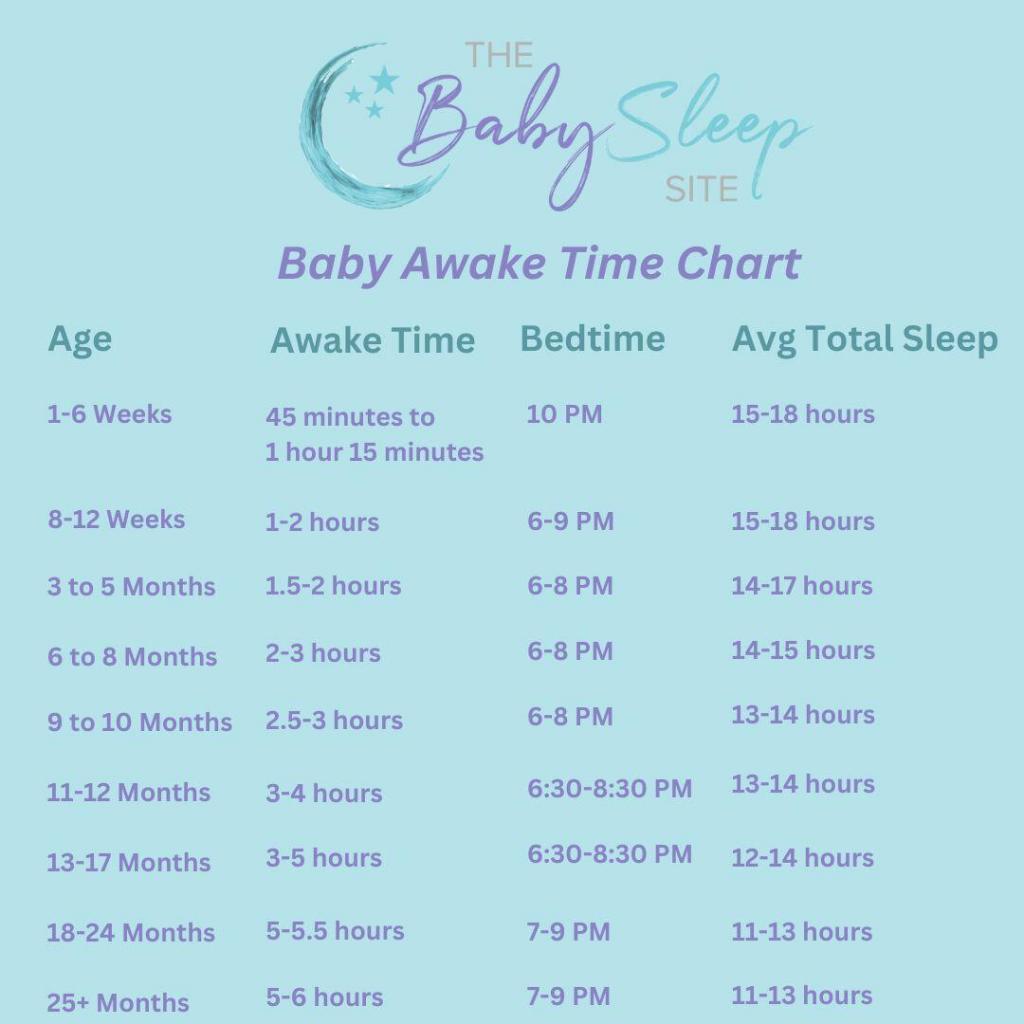
Newborn Awake Time
Newborns have short awake times, sometimes as short as 45 minutes to one hour. In the early days, it’s not uncommon to feel like your baby wakes up, you feed them, change their diaper, and put them back to sleep. This is especially true if they take a long time to eat and have a longer breastfeeding frequency, for example. Don’t worry as they start to stay awake longer in no time and will become more fun!
You may also be interested in…
Awake Time for 8-12 Week Olds
Young babies from 8 to 12 weeks old typically have awake times of 1-2 hours. Usually, the first awake time is the shortest even though you would think it’s the opposite after a full night’s sleep! The first awake time could be just one hour but your baby might stay awake 1.5 to 2 hours the rest of the day. Not all awake times are necessarily the same all day!
You may also be interested in…
Awake Time at 3 to 5 Months
Now that your baby is no longer a newborn, your 3 to 5-month old is staying awake 1.5 to 2 hours at a time. This is a very common age to start having sleep problems with the onset of the 3 month sleep regression and/or the 4 month old sleep regression. Babies this age sometimes wake frequently at night and/or take short naps.
You may also be interested in…
Awake Times for 6-8 Month Olds
At 6 to 8 months old, most babies are staying awake for 2 to 3 hours during the day and up to 4 hours before bedtime if they’ve dropped to two naps. Some babies will stay awake just 2 hours before their first nap and 2 1/2 to 3 hours for the remainder of the day. Be sure to review our baby awake time chart below to find the right mix for your baby. This is a common age to have a more regular sleep schedule until your baby hits the 8 month sleep regression.
You may also be interested in…
Awake Time at 9 to 10 Months
9 to 10-month-old babies stay awake about 3 hours before their two naps and 3-4 hours before bedtime. Some 9-month-olds can stay awake just 2 1/2 hours before their first nap but if they aren’t long nappers, this can make the 9-month-old schedule challenging. This is a common age to hit the 9 month sleep regression which is exhausting for both babies and parents!
Awake Times for 11 to 12 Month Olds
As you approach your baby’s first birthday, your schedule is likely more regular and predictable. This can be a great feeling for new parents! 11 to 12 month old babies stay awake 3 to 4 hours before naps and bedtime. The biggest challenge in this age range is the 12 month sleep regression.
Awake Times for 13 to 17 Month Olds
Toddlers from 13 to 17 months old are usually transitioning to one nap so their awake times can vary from 3 to 5 hours. The signs to drop to one nap include skipping one of their naps at least 4 times a week, pushing bedtime past 9 or 10 p.m., insomnia in the middle of the night (also known as a split night), and nighttime sleep dropping to under 10 hours.
Awake Times for 18-24 Month Old Toddlers
Older toddlers who are approaching their 2-year birthday can be challenging for many reasons. Most 18- to 24-month-old toddlers have awake times of 5 to 5 1/2 hours. They are usually less sensitive to being overtired and can be headstrong about going to bed. There is a reason the 18-month sleep regression is one of the hardest.
Awake Time for 2 Year Olds
After 2 years old, awake times vary from 5 to 12 hours depending on whether your child is ready to stop napping altogether. Most 2-year-olds, however, are awake 5 to 6 hours before and after their nap before bedtime.
Baby Awake Time Chart
Be sure to pin or print this handy baby awake time chart so you’re keeping your baby on the best sleep cycle for their age!
Frequently Asked Questions About Baby Awake Times
In the past 15 years as a sleep consultant, there are many questions which is why we have over 500 articles about this topic. Here are some of the most common questions relating to awake time:
No, they change throughout the day. The common misconception is that your baby’s awake times are constant but that’s NOT true! For most babies, the first awake time will be the shortest and then they will get longer as the day progresses. However, there are some babies who have short awake times right before bed, too, especially newborns and younger babies.
Babies who are overtired are usually very fussy, rub their eyes, scratch at their faces, and sometimes pull their own hair. Remember, crying is the last sign your baby will give. To avoid baby getting overtired, look for more subtle signs such as staring off into space and yawning. If your baby yawns, that is a sign overtiredness is coming soon!
Most babies can stay awake for 3 hours when they are 6-8 months old. That does not mean, however, they can stay awake for 3 hours all day. Some babies will stay awake for 2 to 2 1/2 hours first thing in the morning and then 3 hours for the remainder of the day, for example.
Yes, an overtired baby will eventually sleep, however, sometimes not soundly. Overtired babies wake frequently at night and take short naps much of the time.
To break an overtired cycle, put baby down with a shorter awake time for 1-2 days and give them every opportunity to sleep as much as they can.
The number of naps your baby needs depends on their age and stage of development. Be sure to check out our Baby Nap Chart By Age.